
Ports#
Role in SysML v2#
A port definition defines a connection point to enable interactions between parts. A port usage is a usage of a port definition.
A connection definition classifies relationships between related elements, such as items and parts. Two of the owned features of a connection definition must be connection ends, which specify the things that are related by the connection definition. Connection definitions with exactly two connection ends are called binary connection definitions, and they classify binary connections.
A port must have a direction (in or out at present). Presently only binary connections are supported
Mapping to C++#
The framework defines the base classes Port and InputPort. They provide functionality to send and receive events or data via ports. Presently it is required to create own derived classes and overwrite the process and handle methods to implement your handling logic.
Item-typed ports and accept#
Ports may carry items (or attributes) as payload. A common pattern is to receive data in an action with a typed accept and bind it to a variable. Generated code can access the port message via getPayload():
item def PortData {
    attribute msg : DeviceEvent;
}

port def ControlPortData {
    in item data : PortData;
}

action getMsg {
    action accept m:PortData via recvPort {
        assign msg := m.msg;
    }
}Sending#
send … via <port> writes to an out port. The payload struct in the generated code is derived
from the port type, not from the item type written at the call site, so these two lines
produce the same C++:
then send DeviceEvent::evReady via sendPort;
then send new PortData(DeviceEvent::evReady) via sendPort;
Both become sendPort.send(ControlPortDataDef{{DeviceEvent::evReady}});. The plain form is the
simpler one and is what the examples use.
Ports declared on a base part are found from a specializing part as well, so this works:
part def BaseController {
    out port servicePort : ServicePort;
}

part def Controller :> BaseController {
    action report {
        first start;
        then send DeviceEvent::evReady via servicePort;   // port comes from BaseController
    }
}
If the port cannot be resolved at all, the generator reports E3119 instead of emitting code that will not compile.
Example#
SysML v2 source code:
 1private import ScalarValues::*;
 2
 3package Test {
 4
 5  port def MyPort {
 6    attribute dataValue : Integer;
 7  }
 8
 9  part def PartA {
10    doc /*
11      * Generates data and sends it to other parts via this port
12      */
13    out port myPort : MyPort;
14  }
15
16  part def PartB {
17    doc /*
18    * Receives data via port
19    */
20    in port myPort : ~MyPort;
21  }
22
23	// Main system composition
24	part def System {
25		doc /*
26		 * Main system that contains the parts
27		 */
28		part partA : PartA;
29		part partB : PartB;
30
31		// Connect the parts
32		connect partA.myPort to partB.myPort;
33  }
34} // namespace
C++ source code:
 1#include <framework.h>
 2
 3namespace Test {
 4struct MyPortDef {
 5  int dataValue;
 6};
 7
 8using MyPort = std::variant<MyPortDef>;
 9
10class PartA : public Part {
11
12public:
13  PartA() {}
14
15  Port<MyPort> myPort;
16
17  virtual void process() override {}
18
19  // must be called by derived classes after constructing the parts
20  virtual void init(void) override {}
21};
22
23class PartB : public Part {
24
25public:
26  PartB() {
27    myPort.addHandler([this](const MyPort &e) {
28      std::visit([this](auto &&ev) { handle(ev); }, e);
29    });
30  }
31
32  // called by process() to handle received event
33  virtual void handle(const MyPortDef &e) { assert(false); };
34
35  InputPort<MyPort> myPort;
36
37  virtual void process() override { myPort.process(); }
38
39  // must be called by derived classes after constructing the parts
40  virtual void init(void) override {}
41};
42
43class System : public Part {
44
45public:
46  System() {}
47
48  std::unique_ptr<PartA> partA = std::make_unique<PartA>();
49
50  std::unique_ptr<PartB> partB = std::make_unique<PartB>();
51
52  virtual void process() override {
53
54    partA->process();
55
56    partB->process();
57  }
58
59  // must be called by derived classes after constructing the parts
60  virtual void init(void) override {
61    assert(partA);
62    assert(partB);
63    partA->init();
64
65    partB->init();
66
67    connect(&partA->myPort, &partB->myPort);
68  }
69};
70
71} // end of namespace Test
Delegating a port to a part inside#
A part built from other parts often has ports that nothing in it reads or writes itself: what arrives on the boundary belongs to an inner part, and what an inner part produces leaves through the boundary. Such a port is delegated rather than connected - the boundary port and the inner port are one and the same feature, under two names.
item def PortData {
  attribute value : Integer;
}

port def DataPort {
  in item payload : PortData;
}

part def Inner {
  in port inPort : ~DataPort;
  out port outPort : DataPort;
}

part def B {
  in port inFromOuter : ~DataPort;
  out port outToOuter : DataPort;

  part b1 : Inner;
  part b2 : Inner;

  connect b1.outPort to b2.inPort;   // a connection between two parts

  bind inFromOuter = b1.inPort;      // a delegation through the boundary
  bind outToOuter = b2.outPort;
}
Drawn with -l svg -t PortDelegation::B, a delegation carries a colour of its own - blue, where
a connection is drawn in the line colour - because the two say different things: a connection
carries something between two ports, a delegation says the two are one. Ports sit on the side
their direction says: what the part receives on the left, what it sends on the right.
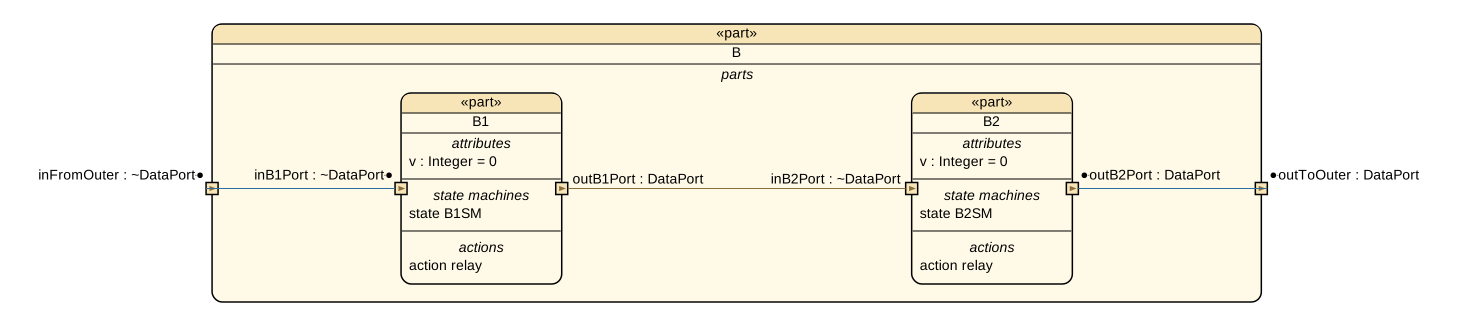
In C++ a delegated port is not a second port that something copies into. It is a reference to the inner one, so nothing is wired and nothing is forwarded:
InputPort<DataPort>& inFromOuter = b1->inPort;
Port<DataPort>&      outToOuter  = b2->outPort;
Whatever the outside connects to B.inFromOuter therefore arrives in b1, and a receiver
attached to B.outToOuter hears what b2 sends. The Python back end binds the two names to the
same object for the same reason.
bind inFromOuter = b1.inPort;andconnect inFromOuter to b1.inPort;are both accepted and produce the same code; use one of them per port. Stating a delegation twice is reported as E3231, as are two ports that face opposite ways or carry different port types. A boundary port stands for exactly one inner port - it cannot be delegated to two of them.